
Beyond the Headlines: Using AI to Dissect Cory Booker’s 25-Hour Speech
Harnessing generative AI to reveal the real insights, topics, and sentiments behind a record-breaking address.

When Cory Booker gave his record breaking 25 hour speech there were lots of articles, headlines, and videos calling out the achievement. What I found was missing was any real insights into what he talked about. After all, 25 hours is a lot of material to condense into an article, but I was surprised that no one really tried.
I think this is a perfect use case for AI. Segmenting and classifying Cory Booker’s speech into topics and try to find some true insights.
What did Cory Booker say?
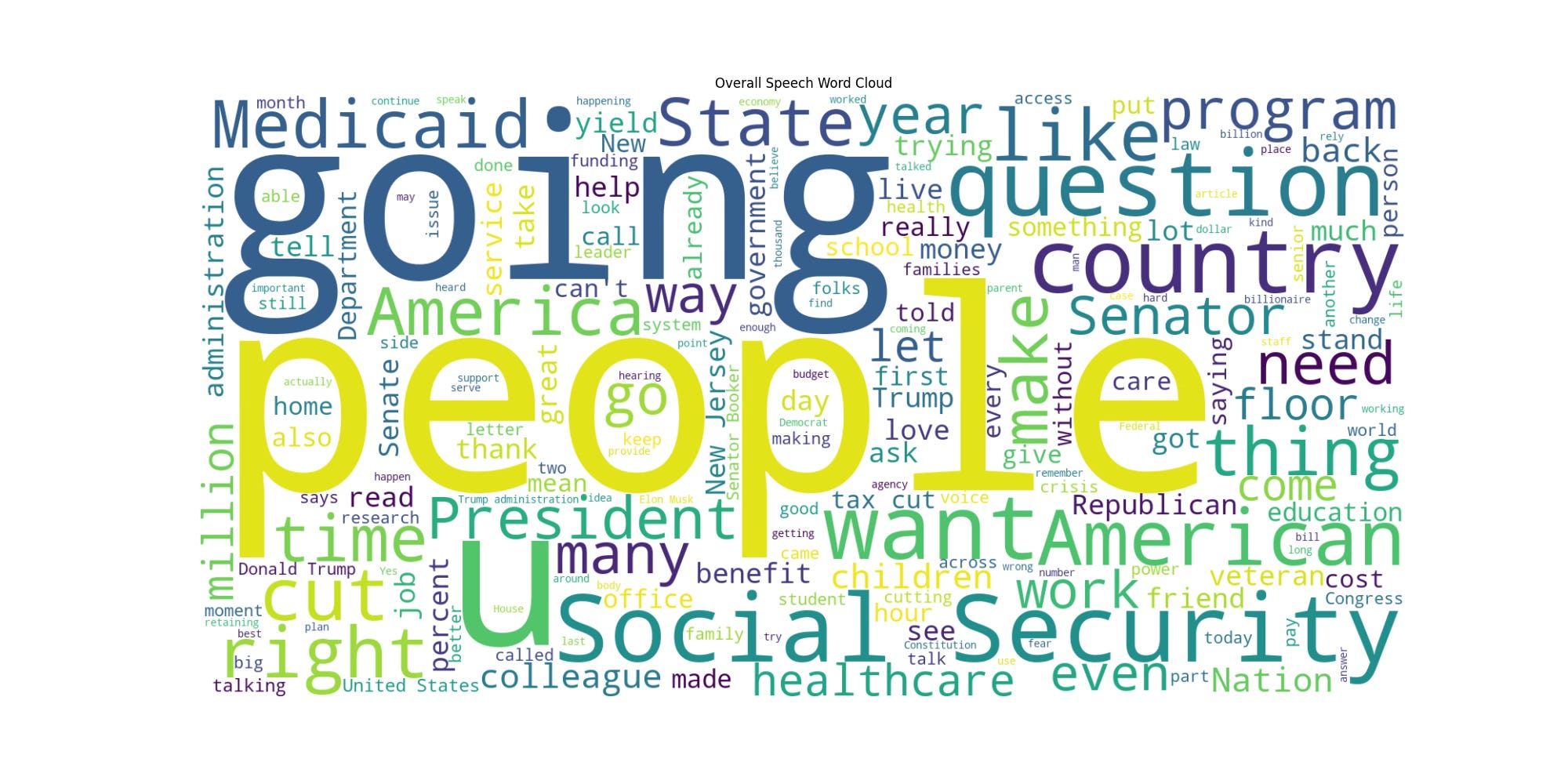
Throughout his speech Cory Booker spent time talking about many things, but a large amount reading letters and stories written by Americans. You can see in the word cloud the speech was focused on people. Putting real stories to the conversations he was having. There was a large emphasis on Social Security and Health Insurance.
What did he talk about?
We leveraged generative AI to help classify each paragraph and sentence into different categories. You can see much of the speech was made with personal statements he used to back up his other positions.. Cory Booker spent a lot of time referencing colleagues, constituents, opposition, and history.
How did he say it?
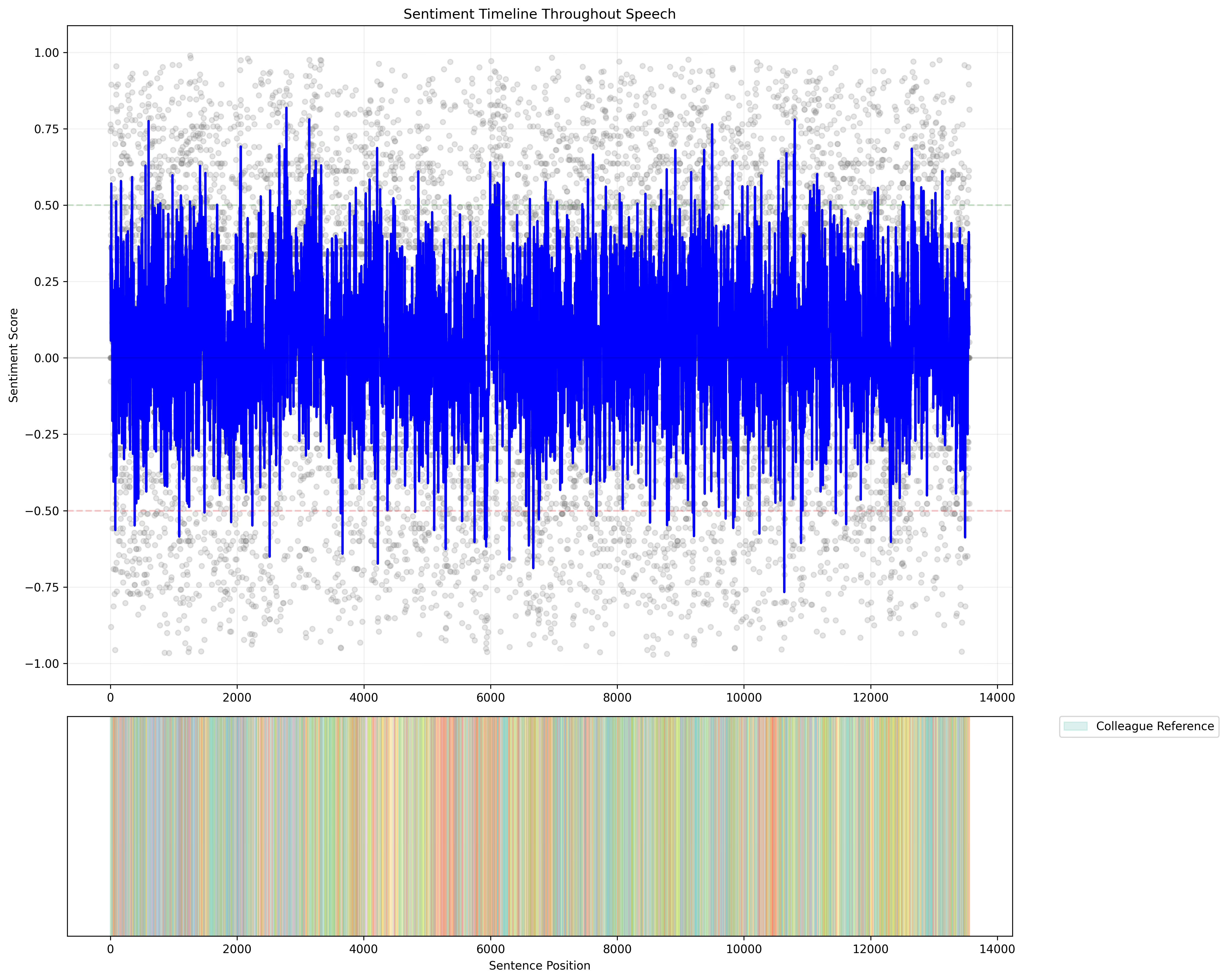
Overall the speech fluctuated greatly on sentiment. There were moments of positivity followed by negativity. Broken down by topic it further fills in the details.
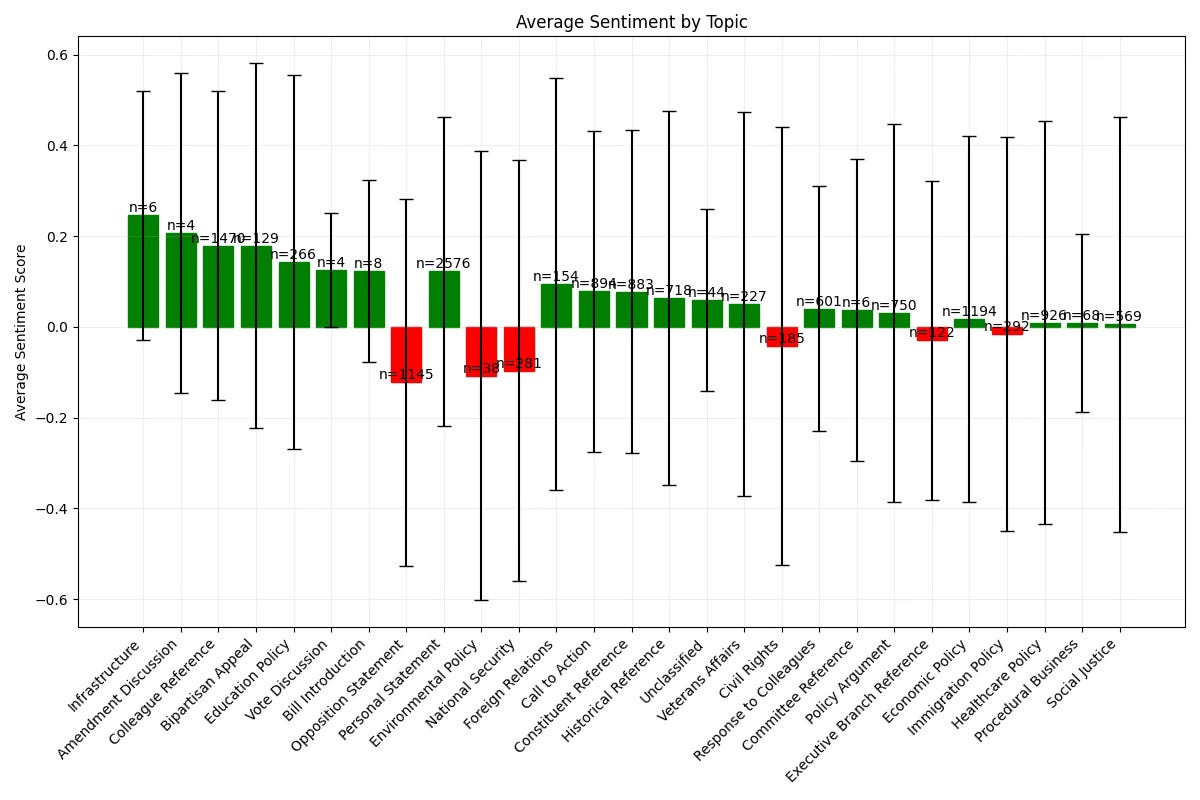
Cory Booker was unsurprisingly the most negative while talking about the opposition. You can see with the whiskers on the chart he wasn’t purely positive or negative about any topic with both positive and negative aspects discussed. Some standouts include discussing the failings around environmental policy, set backs in civil rights and immigration policy.
On average the speech was actually almost exactly neutral (average 0.0, median 0.055).
Who did he talk about?
There were a lot of people referenced throughout his speech with over 600 individuals mentioned. As you can see, a large amount of references were aimed at Donald Trump and Elon Musk. With a common thread throughout the speech and each topic back often referencing back to them.
What’s the point of all this?
This was a thought exercise I did for myself. It was a question I didn’t see an answer to in the initial articles I was reading. With the pace of news and press these days sometimes headlines are all we get. Since Cory Booker’s speech we’ve already had huge news stories culminating in the “liberation day” tariff announcements which have left the markets down 12% and recession indicators up from 40-60% this year.
I guess my main point is this took me less than an afternoon to get my own answer to my question. As this technology grows the walls between sources of truth and data are crumbling. You can get your own answers.
How this can be used in business
These same tools are leveraged for many business purposes including:
Analyzing earnings calls
Email sentiment analysis
Classifying transactions
Contract review
Key terms extraction
Lead generation
Stakeholder identification and analysis
If you have any questions on the art of the possible don’t hesitate to reach out!
Generative AI made this Possible
AI and Generative AI made all of this possible. Leveraging the transcript from the congressional record we were able to run multiple queries across the speech to try to get some structure and analysis across the nearly 230,000 words spoken during the 25 hours. I leveraged AI to do a few things to enable the analysis:
1. Topic Classification
Generative AI is great for classification. Machine Learning has long been used for classifying things into different buckets. Generative AI makes this easier by removing the need for any pertaining. Instead of needing to go through part of the speech and manually classify each sentence or paragraph; We were able to just give the generative AI a menu of topics and asked it to make the assertion of best fit. The tradeoff is the accuracy here tends to have a ceiling, but this use case is fine if it’s only 80% correct. The key output is intended to be directional not needed to be perfect.
2. Name Mentions
We could have used a word bank or some other parsing methodology to try to extract the names of people referenced throughout the speech. That process can be lengthy and is prone to difficulties. Instead leveraging generative AI we were able to scan through each paragraph and pull out any mentioned names. Again this solution isn’t 100% accurate but it’s close enough to get an idea of who is being mentioned and in what context.
3. Sentiment Analysis
AI has been used for sentiment analysis for years. Assigning positive or negative to reviews, emails, etc. We used it for the same process here to help classify if the speech Cory Booker gave was positive or negative and how it changed during the speech.